

Beyond Compliance: How I’m Transforming Security Awareness into Living Culture
Security awareness training has a problem: nobody remembers it. Employees sit through mandatory sessions, click through modules, pass quizzes—and promptly forget everything by the time they return to their desks. After years of watching this pattern repeat, I decided to stop treating security awareness as a compliance checkbox and start building it as an engaging, memorable, integrated part of organizational culture.
The Philosophy: From Awareness to Culture
Traditional security awareness operates on a simple (and flawed) premise: tell people what not to do, test their knowledge, repeat annually. But behavior change doesn’t work that way. Real security culture requires:
Engagement over enforcement: People remember experiences, not lectures
Integration over isolation: Security becomes part of daily work, not separate from it
Creativity over compliance: When learning is fun, retention skyrockets
Continuous reinforcement over annual training: Security mindfulness requires ongoing touchpoints
With this philosophy, I’ve developed and implemented innovative programs that transform how organizations approach security culture—making it visible, accessible, and genuinely engaging.
Innovation 1: The Cyber Day Experience
Instead of another boring lunch-and-learn, I designed Cyber Day a multi-hour immersive experience that turns security awareness into interactive entertainment. Think of it as a security carnival where every booth teaches critical concepts through games, creativity, and fun.
The Booth Experience
AI vs. Human Challenge Booth: Participants guess whether images, text, or content was created by AI or humans, then learn about AI-generated phishing threats and deepfakes. A companion activity, “Prompt or Problem?”, teaches responsible AI usage through scenario cards—helping employees recognize when AI prompts risk data privacy or expose confidential information.
Access Granted Game Booth: Real workplace scenarios test decision-making around file sharing, email forwarding, and permissions. “Should you forward that product roadmap to your personal email? Should you access the marketing folder just because it’s open?” Participants vote whether scenarios are safe or risky, then learn why proper access management matters.
Cyber Coloring Booth: Yes, coloring for adults. Pre-printed cybersecurity-themed sketches let employees relax while learning—scenes showing someone locking their screen, reporting phishing, or handling suspicious USBs. The mindful activity combined with visual learning creates memorable associations. Kids’ versions let employees engage families in security conversations at home.
Wheel of Cyber Fortune: Spin the wheel or draw a chit, answer a cyber quiz question, win prizes. Simple gamification turns knowledge testing into entertainment, with questions ranging from “What do you do if ‘IT Support’ emails asking for your login?” to “Is it safe to charge your phone at airport USB ports?”
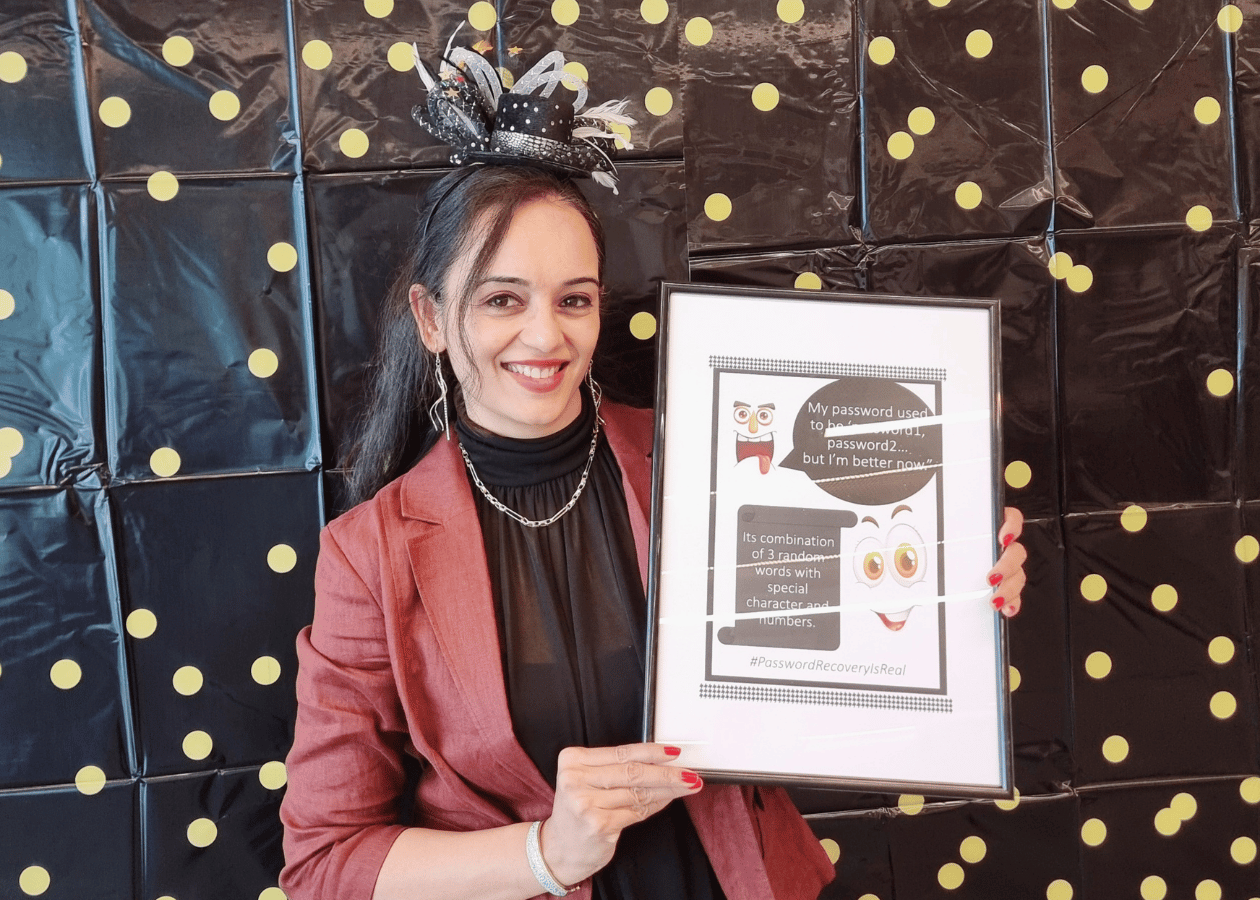
Security Selfie Stage: A red carpet, fun props, and cyber message plaques (“Never Share Passwords,” “Always Lock My Screen”) create Instagram-worthy moments. Photos shared on the company intranet with security tips turn participants into awareness ambassadors.
The Impact of Security Awareness Cyber Day
Cyber Day achieves what months of traditional training can’t it makes security memorable, social, and fun. Employees talk about it. They remember booth lessons. They share photos. Security becomes conversation, not compliance burden.
Innovation 2: Visual Storytelling Through Creative Posters
Making Security Visible
Security lives in the background until something goes wrong. I changed that by designing eye-catching posters strategically placed across office spaces turning hallways, break rooms, and common areas into continuous learning environments.
The Design Philosophy
Visual over text-heavy: Bold graphics that capture attention before people even read the message
Humor and relatability: Security scenarios presented with wit, making concepts approachable rather than intimidating
Practical tips over fear tactics: Focus on what TO do, not just what to avoid
Strategic placement: High-traffic areas where people naturally pause—elevators, coffee stations, restrooms, printer areas
Examples That Worked
Posters comparing password security to protecting house keys—simple analogy everyone understands. Infographics showing phishing red flags using actual email screenshots. Visual guides on secure remote work positioned near exit doors. MFA benefits explained through everyday scenarios like bank ATMs requiring both card and PIN.
The Retention Factor
Research shows visual information is processed 60,000 times faster than text. Creative posters leverage this—employees absorb security messages during coffee breaks, waiting for elevators, or walking to meetings. The passive exposure creates familiarity and retention that formal training sessions struggle to achieve.
Innovation 3: Real-World Phishing Simulations
Beyond Generic Templates
Most phishing simulations fail because they’re obviously fake—outdated templates with grammatical errors that real attackers abandoned years ago. I designed sophisticated phishing campaigns that mirror actual threat actor techniques, reflecting current social engineering trends.
The Realistic Approach
Contextual scenarios: Phishing emails referencing actual company events, systems, or recent announcements
Seasonal themes: Tax season credential harvesting, benefits enrollment urgency, holiday shipping notifications
Executive impersonation: CEO fraud attempts mimicking communication styles and signatures
Multi-channel attacks: Combining email with fake SMS or Teams messages, reflecting blended threat tactics
Current events exploitation: Leveraging breaking news, global events, or industry developments
The Learning Opportunity
Unlike punitive approaches that shame clickers, my simulations turn failures into teaching moments. Immediate educational pop-ups explain what red flags were missed, why the technique works, and how to verify suspicious communications. Follow-up micro-learning modules are tailored to specific vulnerabilities each employee demonstrated.
Measuring Evolution
Track not just click rates but reporting rates the percentage of employees who identify and report suspicious emails. The goal isn’t zero clicks (unrealistic); it’s building a security-conscious workforce that recognizes threats and takes action.
Innovation 4: The Cyber Champion Program
Grassroots Security Leadership
Top-down security mandates create compliance. Bottom-up security culture creates ownership. The Cyber Champion Program embeds security advocates across departments peers who promote best practices, answer questions, and bridge the gap between security teams and business units.
The Champion Model
Voluntary participation: Champions self-select based on interest, not obligation
Cross-functional representation: Every department has at least one champion ensuring diverse perspectives
Regular engagement: Monthly champion meetings sharing threat intelligence, upcoming initiatives, and feedback from their teams
Recognition and empowerment: Champions receive advanced training, exclusive briefings, and visibility as security thought leaders
The Multiplier Effect
One security team member can directly influence perhaps 50-100 employees. Twenty champions across the organization influence thousands creating distributed security awareness that scales effectively. Champions also provide invaluable feedback on security friction points, helping refine policies and tools based on real user experience.
Innovation 5: Cyber Moments – Daily Integration
The One-Minute Revolution
If security only surfaces during annual training or after incidents, it remains separate from daily work. Cyber Moments changed this by integrating one-minute security discussions into regular team meetings.
How It Works
Standing agenda item: Every team meeting starts with a 60-second cyber moment before diving into business topics
Rotating responsibility: Different team members share each week, promoting ownership
Flexible content: Tips, recent news stories, personal experiences, fun facts, lessons learned, or quick reminders
No preparation burden: One minute means no elaborate presentations just authentic sharing
Examples That Resonate
- “I almost fell for a phishing email this week here’s what tipped me off”
- “Did you know your phone’s Wi-Fi auto-connects to networks with familiar names? Here’s how to disable that”
- “Fun fact: The most common password is still ‘123456’ don’t be that statistic”
- “Quick reminder before the holiday rush: verify requests for gift card purchases, even if they seem urgent”
The Cultural Shift
Cyber Moments normalize security conversations. They position security as everyone’s responsibility, not just the security team’s domain. Over time, security thinking becomes reflexive employees naturally consider security implications in daily decisions because it’s part of routine dialogue.
Innovation 6: The Cyber Art Gallery
Making Security Beautiful
Who says security awareness materials must be boring? I curated a Cyber Art Gallery featuring security-themed artwork created by employees—from the Cyber Coloring booth submissions to original digital art, photography, and creative interpretations of security concepts.
The Unexpected Impact
The gallery achieved multiple objectives simultaneously:
Engagement: Employees who participated in creating art became invested in security messaging
Conversation starters: Gallery pieces in common areas sparked spontaneous security discussions
Humanizing security: Showing security’s creative side made the function more approachable
Community building: Shared creative experience fostered connection between employees and security team
The Results: Measuring Cultural Transformation
Quantitative Improvements
While creativity is hard to quantify, the outcomes are measurable:
Phishing click rates: Decreased substantially year-over-year
Incident reporting: Increased dramatically as employees felt empowered to report suspicious activity
Policy compliance: Higher adherence to security requirements without enforcement escalation
Training completion: Near 100% completion rates when training was engaging rather than mandatory drudgery
Qualitative Shifts
The real success shows in cultural indicators:
Proactive questions: Employees asking security teams about best practices before implementing new tools
Peer accountability: Teams organically reminding each other about security practices
Innovation collaboration: Business units involving security early in projects rather than as afterthought
Positive sentiment: Security viewed as enabler rather than blocker
The Broader Lesson: Security Is Human
Technology secures systems. Governance defines requirements. Compliance checks boxes. But people secure organizations and people respond to creativity, engagement, and meaningful connection, not mandates and fear.
Every innovative approach I’ve implemented stems from one fundamental insight: security awareness fails when it treats humans as the weakest link to be fixed. It succeeds when it recognizes humans as the adaptive defense to be empowered.
Replicating Success: Key Principles
For security leaders looking to transform their awareness programs:
Start with empathy: Understand why employees resist security usually because it creates friction or feels irrelevant
Make it memorable: Experiences stick better than information
Reduce friction: Security that’s easy to do right gets adopted; security that’s hard gets circumvented
Celebrate participation: Recognize and reward security-positive behaviors
Iterate based on feedback: Employees know what works in their environment listen to them
Measure what matters: Track behavior change, not just training completion
The Journey Continues
Security culture isn’t built in a day, or even a year. It’s continuous evolution—experimenting with new approaches, learning what resonates, refining programs based on feedback, and staying creative in an industry that too often defaults to dry compliance.
From Cyber Day carnivals to hallway posters, from sophisticated phishing simulations to one-minute meeting moments, each innovation represents the same commitment: making security awareness something people want to engage with, not something they’re forced to endure.
Because when security becomes part of organizational DNA rather than an external imposition, that’s when real resilience emerges. That’s when employees become the strongest defense rather than the weakest link. And that’s when security culture truly transforms from compliance obligation to competitive advantage.
Looking to transform security awareness in your organization? Interested in creative approaches to building security culture? Let’s connect and explore how innovative engagement strategies can strengthen your security posture while energizing your teams.
By – Pooja Shimpi | Cybersecurity GRC & AI Governance Advisor | Security Culture
